How to Convert GPA Into Percentage (India, USA & Pakistan)
How to Convert GPA Into Percentage
Students often need to convert their Grade Point Average into a percentage for university admissions, scholarships, job applications, visa processing, and international transcript evaluations. Because grading systems vary drastically worldwide, figuring out how to convert gpa into percentage can be confusing.
Whether you are dealing with a 4.0 scale or a 10.0 scale, this comprehensive guide explains everything. To save time, you can instantly calculate your results using our GPA to Percentage Calculator or our Percentage to GPA 10 Scale Calculator.
GPA to Percentage Formula
What is GPA to percentage conversion? It is the mathematical translation of your academic grade point average into a 100-point percentage scale. The formula you use depends entirely on your country’s grading policies.
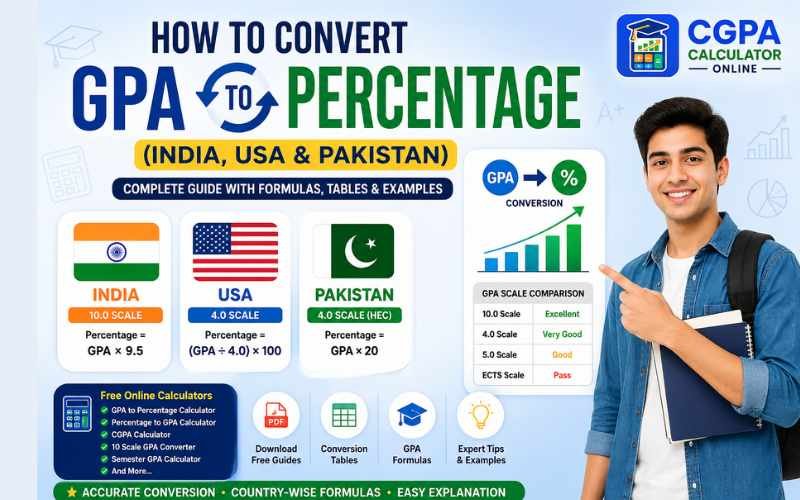
- USA & Pakistan (4.0 Scale):
Percentage = (GPA ÷ 4.0) × 100 - India (10.0 Scale):
Percentage = CGPA × 9.5(Standard UGC Method)
Note: Different universities may apply custom formulas. Always verify with your official transcript.
What Does GPA Mean?
If you are a new student, you might be asking, what is gpa mean? GPA stands for Grade Point Average. It is an internationally recognized academic scoring system used by high schools, colleges, and universities to measure a student’s overall scholastic performance.
Instead of awarding you a direct percentage (like 85%), institutions assign a numerical value to your letter grades (e.g., A = 4.0, B = 3.0). These numbers are then averaged out over the semester.
- Semester GPA: This measures your performance for one specific academic term.
- Cumulative GPA (CGPA): This is the credit-weighted average of all your semesters combined, representing your entire degree performance.
- Weighted vs Unweighted GPA: Used heavily in US high schools, weighted GPAs award extra points for difficult AP or Honors classes (scaling up to 5.0). To see how this works, you can use our Weighted and Unweighted GPA Calculator.
How to Convert GPA Into Percentage
Figuring out how to convert gpa into percentage is relatively simple once you identify the maximum scale your university utilizes. Most of the world operates on either a 4.0 scale or a 10.0 scale.
Percentage = (Obtained GPA ÷ 4.0) × 100
Percentage = GPA × 9.5
Example Calculations
Let’s look at some practical gpa to percentage calculation examples based on common student queries:
- 3.5 GPA to percentage (4.0 Scale): (3.5 ÷ 4.0) × 100 = 87.5%
- 3.7 GPA to percentage (4.0 Scale): (3.7 ÷ 4.0) × 100 = 92.5%
- 3.8 GPA to percentage (4.0 Scale): (3.8 ÷ 4.0) × 100 = 95.0%
- 10 GPA to percentage (10.0 Scale): 10.0 × 9.5 = 95.0%
- 7.8 CGPA in percentage (10.0 Scale): 7.8 × 9.5 = 74.1%
- 7.2 CGPA in percentage (10.0 Scale): 7.2 × 9.5 = 68.4%
Stop Doing Manual Math!
Are you applying for a scholarship or checking your admission eligibility? Don’t risk making a mathematical error on your application. Use our free, automated educational calculators to get 100% accurate results instantly.
GPA to Percentage Calculator Global CGPA Calculator College GPA CalculatorGPA to Percentage in India
If you are an Indian student, understanding how to calculate percentage from cgpa is critical. Most Indian universities, including those under the University Grants Commission (UGC) and AICTE, use a 10-point CGPA grading system. The standard formula approved by the CBSE and UGC is multiplying your CGPA by 9.5.
However, engineering universities often establish their own autonomous conversion rules. For example:
- Standard UGC:
Percentage = CGPA × 9.5 - Direct Multiplier: Some universities simply use
Percentage = CGPA × 10. - Offset Formula: Institutions like Mumbai University or VTU have historically utilized formulas like
(CGPA − 0.75) × 10.
If an employer asks you to convert cgpa into marks, you first calculate your percentage, and then multiply that percentage decimal by the maximum available marks for your degree.
India 10-Point Conversion Table
| CGPA (10 Scale) | Percentage (x 9.5) | Academic Division |
|---|---|---|
| 10.0 | 95.0% | First Class with Distinction |
| 9.0 | 85.5% | First Class with Distinction |
| 8.0 | 76.0% | First Class |
| 7.0 | 66.5% | First Class |
| 6.0 | 57.0% | Second Class |
GPA to Percentage in the USA
In the United States, academic transcripts rarely show a percentage. Everything is based on letter grades (A, B, C) mapped to a 4.0 scale. When international companies or programs ask for a conversion from percentage to gpa or vice versa, they use a standard linear estimate.
By using the formula (GPA ÷ 4.0) × 100, you can easily answer common questions like what is a 3.5 gpa to percentage? (It is 87.5%).
USA Conversion Table (4.0 Scale)
| GPA (4.0 Scale) | Approximate Percentage | Letter Grade |
|---|---|---|
| 4.0 | 93% – 100% | A / A+ |
| 3.7 | 90% – 92% | A- |
| 3.5 | 87% – 89% | B+ |
| 3.0 | 83% – 86% | B |
| 2.5 | 77% – 79% | C+ |
| 2.0 | 73% – 76% | C |
HEC GPA to Percentage in Pakistan
Pakistani university grading systems are governed by the Higher Education Commission (HEC). The hec gpa to percentage conversion operates on a “bracket” system rather than a direct multiplier.
For example, if a student asks what a 3.2 gpa to percentage is, a linear calculation (3.2 / 4.0 * 100) gives 80%. However, under strict HEC brackets, a 3.0 to 3.49 often translates to the 71-79% range, while a 4.0 is awarded for 85% and above.
Pakistan HEC Conversion Bracket
| GPA (4.0 Scale) | HEC Percentage Bracket | Classification |
|---|---|---|
| 4.00 | 85% – 100% | Excellent |
| 3.66 | 80% – 84% | Very Good |
| 3.33 | 75% – 79% | Good |
| 3.00 | 71% – 74% | Above Average |
| 2.50 | 65% – 69% | Average |
| 2.00 | 61% – 63% | Pass |
Always refer to the grading legend printed on your official university transcript.
How to Calculate GPA From Percentage
If you only have your percentage and need to find your GPA, you can reverse the formulas. This is essential for Indian or UK students applying to US universities.
- How to convert percentage to gpa (US 4.0 Scale): Divide your percentage by 100, then multiply by 4.0. E.g.,
(85 ÷ 100) × 4.0 = 3.4 GPA. - Percentage to gpa 10 scale (India): Divide your percentage by 9.5. E.g.,
76% ÷ 9.5 = 8.0 CGPA.
You can automate this process using our CGPA to Percentage Calculator.
Visualizing the Conversion Process
1. Check Your Scale
Identify if your university uses a 4.0, 5.0, or 10.0 scale.
2. Apply Formula
Use (GPA/Max) × 100 or multiply by 9.5 for India.
3. Verify Transcript
Always check the back of your official marksheet for exceptions.
Practical Tips to Improve GPA
If your converted percentage is lower than required for that dream scholarship, don’t worry. Try these proven GPA recovery techniques:
- Strategic Semester Planning: Use a Semester GPA Calculator to plan out the exact grades you need in upcoming subjects to raise your cumulative average.
- Focus on High-Credit Courses: A 4-credit calculus course impacts your GPA twice as much as a 2-credit elective. Prioritize your study time accordingly.
- Maximize Attendance & Assignments: Internal marks often account for 20% to 30% of your total grade. Secure these easy points to relieve pressure from final exams.
- Retake Failed Classes: Most universities offer grade forgiveness. Retaking an ‘F’ grade replaces the 0.0 in your GPA calculation, providing a massive overnight boost to your percentage.
Common GPA Conversion Mistakes Students Make
When applying for jobs or international admissions, avoid these critical errors:
- Using the wrong scale: Multiplying a 4.0 scale GPA by 9.5 will give you a disastrously low percentage. Always know your country’s scale.
- Ignoring university autonomy: While UGC sets guidelines, autonomous engineering colleges in India often use their own strict formulas.
- Using unofficial conversion for WES: If you are applying to the US or Canada, WES (World Education Services) will evaluate your transcript course-by-course rather than accepting a simple percentage conversion.
Frequently Asked Questions
General Conversion
GPA stands for Grade Point Average. It is a numerical representation of a student’s academic performance, typically scored on a 4.0 or 10.0 scale, calculated by dividing total quality points by total credit hours.
No, the USA primarily uses a 4.0 scale, India uses a 10.0 CGPA scale, and the UK uses an Honours percentage system. Conversion is necessary for international applications.
Most competitive merit-based scholarships require a minimum GPA of 3.5 on a 4.0 scale (approx 85-87%) or an 8.5 CGPA on a 10.0 scale.
India Specific FAQs
Using the standard UGC multiplier (7.8 × 9.5), it equals 74.1%.
It equals 68.4% (7.2 × 9.5). This falls comfortably within the First Class division.
First, convert the GPA to a percentage using the 9.5 multiplier. Then multiply that percentage decimal by the maximum marks assigned to your degree program.
Yes, an 8.0 CGPA (76%) is considered a very strong academic profile and safely clears the cutoff for almost all campus placements and off-campus recruitment drives in India.
USA Specific FAQs
On a strict 4.0 scale, a 3.5 mathematically equals 87.5%.
A 3.7 GPA equals 92.5%, which is widely considered an A- average.
A 3.0 GPA (roughly an 80% or ‘B’ average) is considered the standard benchmark of “Good Standing.” It is the minimum requirement for many entry-level corporate jobs and graduate programs.
Pakistan Specific FAQs
HEC utilizes a bracket system (e.g., 4.0 = 85%+). However, a quick linear estimation formula used by many is (GPA ÷ 4.0) × 100.
Yes, a 3.0 GPA typically places a student in the 71-74% bracket, marking an Above Average academic performance suitable for most master’s degrees and employment opportunities.
Always refer to the official grading legend provided on your university transcript, as autonomous engineering and medical universities may have slight deviations from standard HEC brackets.
Expertise & Academic Trust
Created by the CGPA Online Calculator educational tools team, bringing deep expertise in GPA systems, academic grading standards, CGPA conversion methods, and international university admission requirements. All formulas presented align with the latest guidance as of May 2026.
Disclaimer: GPA and percentage conversion methods vary across universities, countries, grading systems, and institutions. Students should verify official conversion rules from their university registrar before using these results for formal admissions, visa processing, or academic documentation.